The Ultimate Guide to Soldering Station in the UK
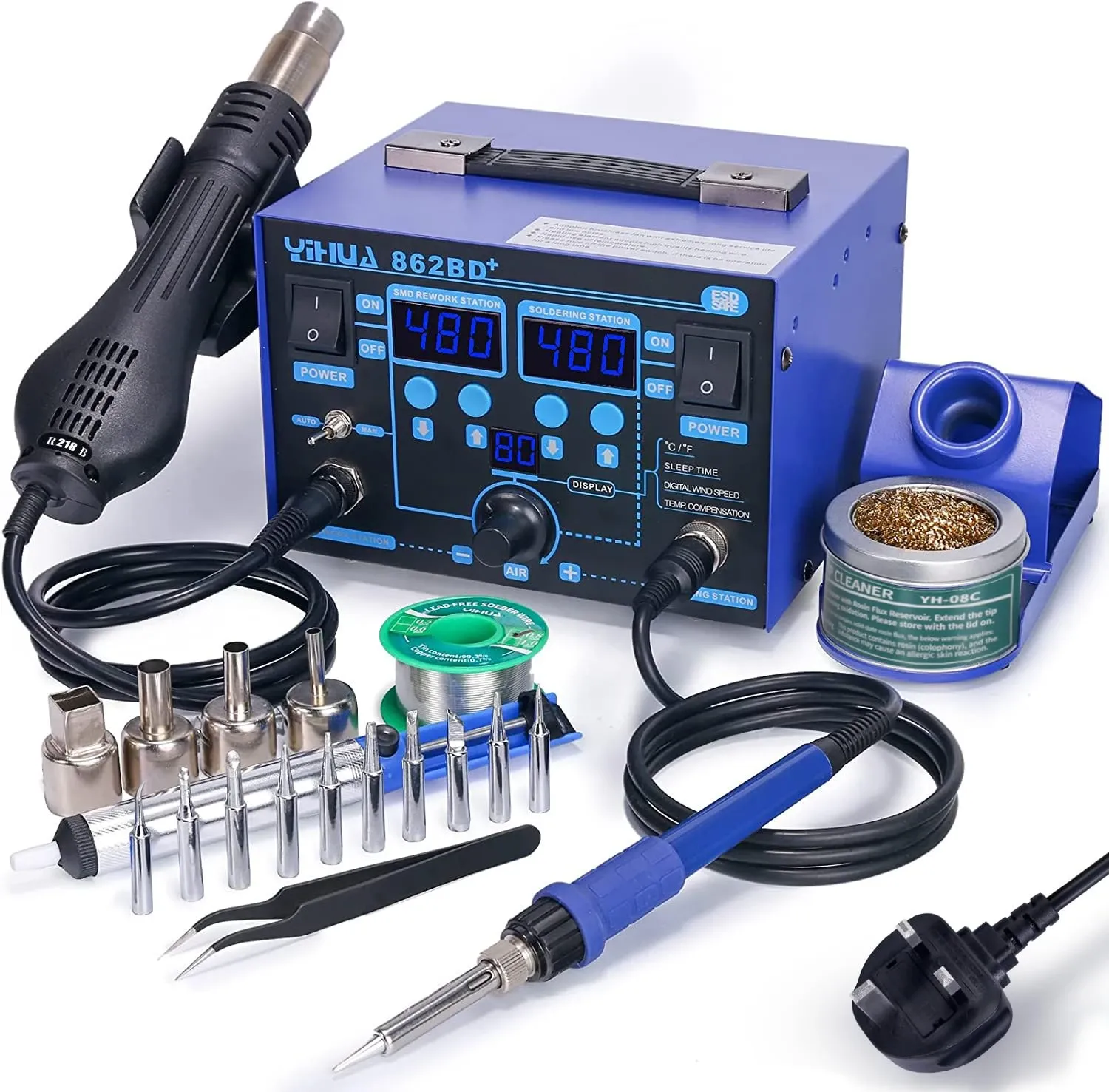
A soldering station is a temperature-controlled soldering system with a base unit, handpiece and interchangeable tips, designed to deliver safer, more precise and more consistent soldering than a basic plug-in iron. For UK users, the right soldering station helps with PCB repair, SMD work, lead-free soldering and ESD protection, while also matching 230V mains requirements and normal workshop safety standards.
TL;DR: If you are choosing a soldering station in the UK, prioritise stable temperature control, fast thermal recovery, ESD safety, comfortable handpiece design and compatibility with lead-free solder. Based on our testing across common repair tasks, most users are best served by a 60W to 75W temperature-controlled station with readily available replacement tips and a genuine UK plug.
Component-level diagnostics and micro-soldering are no longer niche skills reserved for aerospace engineers. With the UK's electrical equipment repair market valued at approximately £1.4 billion in recent industry analyses (IBISWorld, 2023), the demand for reliable, trade-quality repair infrastructure is accelerating. Whether you are an electronics repair professional, an apprentice electrician or a dedicated hobbyist, the bedrock of any capable workbench is a high-performance soldering station.
However, a standard plug-in soldering iron might only suffice for joining heavier-gauge audio wires or basic repairs. Modern surface-mount devices (SMD) and multi-layer printed circuit boards (PCBs) require far greater thermal precision. A dedicated soldering station isolates the power supply, integrates rapid temperature regulation and helps protect sensitive components against electrostatic discharge (ESD). This guide explains what a soldering station is, how it works and what UK buyers should look for.
What should you look for in a soldering station?
- Thermal stability matters: Modern stations often use PID control to keep tip temperatures highly consistent, which is especially important for lead-free PCB work.
- UK electrical compatibility is essential: Choose a unit designed for UK 230V/50Hz supply with a genuine BS 1363 fused plug.
- Wattage affects recovery speed: In practice, 60W to 75W gives most users enough thermal recovery for ground planes and general electronics repair.
- ESD protection is important: For logic board work, an ESD-safe station reduces the risk of damaging sensitive components.
- Tip availability should not be overlooked: A good station is easier to live with when replacement tips and consumables are easy to source in the UK.
- 2-in-1 systems can save bench space: If you regularly remove SMD parts, integrated hot air rework may be worthwhile.
What is in a soldering station?
Understanding the internal architecture of a soldering station makes it easier to compare models and troubleshoot faults. In simple terms, it is a closed-loop heating system built for consistency rather than raw heat alone.
What does the base unit do?
The base unit usually contains the power conversion stage, control electronics and user interface. In many professional designs, it reduces UK mains voltage to a safer low-voltage output for the handpiece. This low-voltage operation helps protect delicate electronics from leakage and also reduces shock risk for the operator. In addition, the base manages temperature settings through either an analogue dial or digital display.
What does the handpiece do?
The handpiece connects to the base via a heat-resistant cable, often made from flexible anti-static silicone. Inside sits the heating element and tip assembly. Better stations typically use ceramic heating technology because it heats quickly, transfers heat efficiently and lasts longer in regular use. Just as importantly, the grip should remain comfortable during long repair sessions.
Why does a soldering station need a temperature sensor?
A built-in sensor such as a thermocouple continuously checks tip temperature. When the tip touches a cooler joint or large copper area, heat drops immediately. The station then responds by feeding more power to restore the set temperature. This feedback loop is what separates a proper soldering station from an inexpensive uncontrolled iron.
How do you choose the best soldering station for UK use?
Selecting a soldering station means looking beyond marketing claims and focusing on practical specifications. According to UK workplace electrical safety expectations and normal bench-use best practice, safe mains compatibility, thermal control and ESD protection should all be considered from the outset.
How much wattage does a soldering station need?
A common misunderstanding is that higher wattage simply means higher heat. In reality, wattage mainly determines how quickly the tool can recover when heat is drawn away by the joint. This matters because lead-free solder used across the UK and Europe under RoHS requirements melts at around 217°C, which is notably higher than traditional tin-lead alloys.
Based on our testing across connector work, pad reflow and larger ground-plane joints, lower-powered irons tend to struggle when copper mass increases. By contrast, a 60W to 75W soldering station generally provides enough recovery speed to complete joints quickly without dwelling too long on nearby components.
What is PID temperature control on a soldering station?
Basic units may rely on simple switching control with wider swings above and below the target temperature. More advanced stations use PID (Proportional-Integral-Derivative) logic to predict heat loss and adjust power rapidly. As a result, tip temperature remains steadier during fine-pitch work such as flex cables or small SMD components.
Why is ESD safety important?
Static electricity can damage semiconductors even when there is no visible sign of failure at the bench. An ESD-safe soldering station uses grounded materials and proper earthing paths so stray charge can dissipate safely through the mains earth connection. Therefore, if you repair motherboards, game consoles or phone logic boards, ESD-safe design should be treated as essential rather than optional.
Does tip selection matter?
Yes — often more than first-time buyers expect. A fine conical tip may suit touch-up work on small pads, whereas chisel tips are usually better for drag soldering or transferring heat into larger joints efficiently. Consequently, one of the easiest ways to improve results is to choose a soldering station with good tip availability in multiple sizes from UK stockists.
What is a soldering station used for?
The role of a soldering station has expanded alongside modern electronics repair. As boards have become denser and components smaller, stable heat delivery has become more important than ever.
Can you use a soldering station for PCB repair?
Yes — this is one of its main uses. A quality soldering station allows controlled work on pads, connectors, wires and through-hole joints while reducing the risk of overheating traces or delaminating boards. For repair benches handling laptops, consoles or industrial control boards in particular, controlled temperature makes repeatable results far easier to achieve.
Is a soldering station good for SMD work?
Yes — especially when precise tip temperature and quick recovery are needed. Historically, through-hole work was more forgiving because component leads passed through drilled holes in the PCB. Today most assemblies rely heavily on surface-mount devices (SMD), which demand much tighter heat control during both installation and rework.
A precision handpiece is useful for individual pins or small passive components. However, removing multi-pin ICs often requires even heating across the whole package at once. This is why combined systems can be so useful on busy benches. For an in-depth look at these board-level workflows, review our Pcb Rework Station Explained: A UK Buyer's Guide.
Ready to upgrade your bench with {brand_name}?
Equip Your Bench — £194.44