Hot Air Soldering Station Explained: A UK Buyer's Guide
By AirRework UK Editorial Team |
Key Takeaways
- A hot air soldering station is designed for controlled SMD rework, component removal, pad clean-up and precision PCB repair.
- For UK buyers, stable temperature control, airflow adjustability, 230V compatibility, spare parts availability and bench safety matter more than headline wattage alone.
- A 2-in-1 bench setup can save space and simplify electronics repair workflows when both hot air and iron work are needed on the same PCB.
- Professional buyers should check compliance, serviceability and realistic operating performance rather than relying on generic marketplace claims.
- If you are comparing stations across repair use cases, see The Ultimate Guide to Soldering Station in the UK for a broader overview.
A hot air soldering station can be the difference between a clean SMD removal and a lifted pad, scorched board or damaged connector. If you repair modern electronics in the UK, whether that means replacing a charging IC, removing a shield can, swapping a USB-C port or reworking fine-pitch components, the tool matters just as much as the operator.
At AirRework UK, the focus is straightforward: precision hot air rework station for PCB repair. That means stable heat, predictable airflow and a practical bench setup that helps users master delicate SMD component removal without unnecessary complexity. For home workshops, independent repair benches and trade environments alike, a temperature-stabilised 2-in-1 solution often makes more sense than buying on marketing language alone.
This guide explains what a hot air soldering station actually does, what features matter to UK buyers, how to avoid common purchasing mistakes and when a combined station is the right fit for real repair work.
What is a hot air soldering station?
A hot air soldering station is a bench tool that delivers controlled heated airflow through a handheld nozzle to heat solder joints on a printed circuit board. It is primarily used for rework rather than conventional through-hole soldering. In practice, that means removing and replacing surface-mount components, loosening adhesive-backed parts, reheating solder around shield covers and assisting with board-level repair where direct iron contact is not enough.
Unlike a basic heat gun, a proper station gives you adjustable temperature and airflow with enough control to work around sensitive components. That control is crucial on densely populated PCBs found in consumer electronics, industrial control boards, telecoms devices and specialist equipment used across British workplaces.
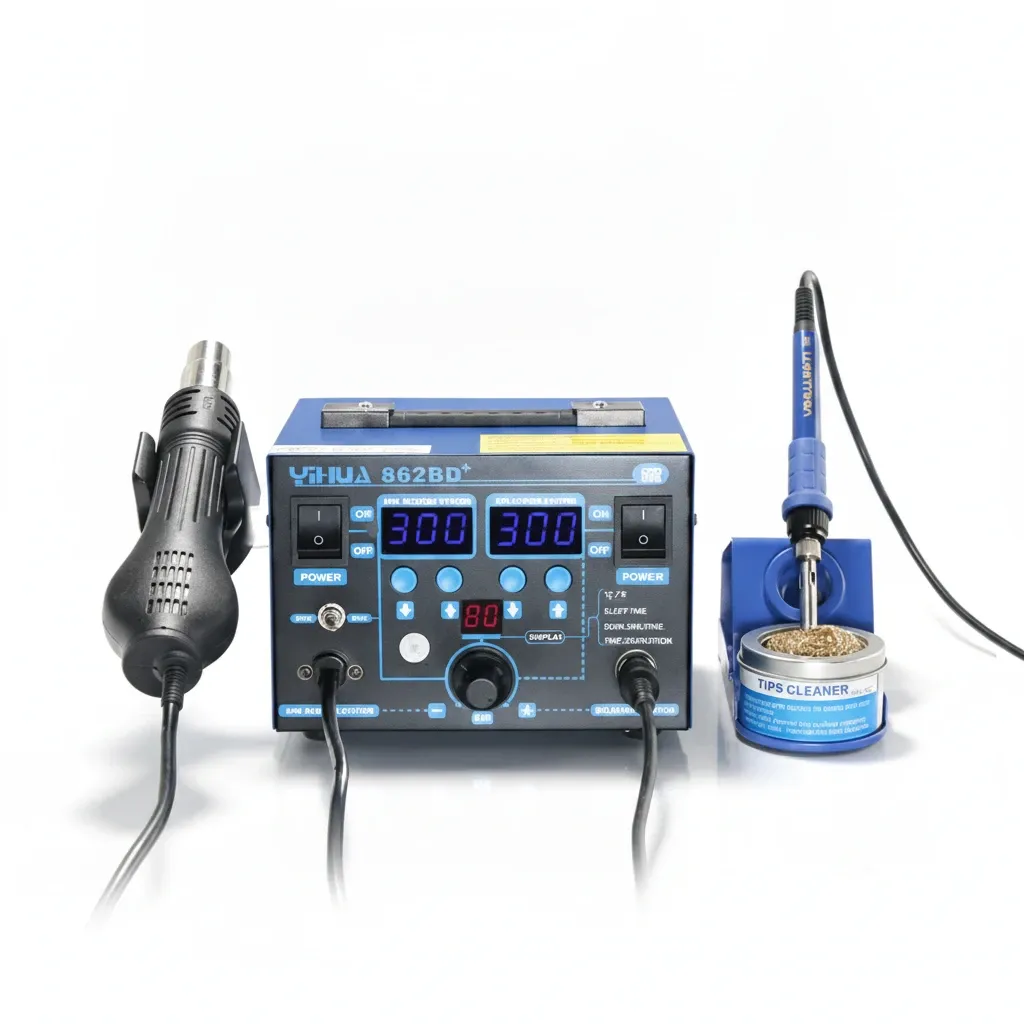
Many UK buyers now prefer a 2-in-1 bench format because it combines hot air rework with a soldering iron in one footprint. For repair technicians and serious hobbyists, that supports a more efficient workflow: remove with hot air, clean pads with the iron, then fit and finish without changing stations.
How a hot air soldering station works in real PCB repair
The station heats air internally and pushes it through an interchangeable nozzle. That heated airflow is directed at the target component and surrounding solder joints. As the solder reaches reflow temperature, the component can be lifted safely using tweezers or vacuum pick-up tools.
The best results come from balancing three variables:
- Temperature — enough to reflow solder without overheating the board
- Airflow — sufficient to transfer heat without blowing nearby parts away
- Dwell time — the shortest practical exposure that completes the task cleanly
For example, removing a small SMD IC calls for lower airflow and careful nozzle choice. Reworking a larger connector or shield can needs broader heat delivery and more patience. The station should respond consistently each time, because guesswork leads to damaged laminate, tombstoned passives and warped plastics.
If you are still deciding where hot air sits within a complete repair setup, our PCB rework station guide explains how rework tools fit into wider bench workflows.
Why UK buyers are choosing hot air rework more often
Modern electronics are smaller, denser and harder to repair with a soldering iron alone. Surface-mount technology dominates everything from mobile devices and routers to automotive modules and medical support equipment. In the UK, this matters not just for independent repair businesses but also for maintenance teams, educational departments and engineering labs trying to extend equipment life.
There is also a clear economic case for better repair capability. According to the UK Government, the UK generated 24.5kg of e-waste per person in 2020, making reuse, repair and longer product life increasingly important in both commercial and domestic settings (Source: GOV.UK, Waste electrical and electronic equipment statistics). A capable hot air soldering station supports repair over replacement, particularly where a failed SMD part would otherwise send an entire board to scrap.
That is one reason organisations under cost presncluding public sector estates and service departments supporting NHS-adjacent equipment maintenance, are paying more attention to practical repair tools. Not every board is repairable, and not every task belongs on a hot air station, but when component-level work is viable, the right station earns its place quickly.
The features that matter most in a hot air soldering station
Temperature stability
The phrase matters more than a high maximum temperature on a spec sheet. A station that overshoots, hunts or drops heat under load is difficult to trust. Stable output helps protect pads, solder mask and adjacent components. For delicate SMD work, predictability is the real performance measure.
AirRework UK’s main product narrative centres on a temperature-stabilised 2-in-1 bench solution, which reflects what experienced users actually need: repeatable results rather than dramatic numbers.
Airflow control
Airflow is not simply about power. Too much airflow can displace nearby resistors and capacitors, especially on compact boards. Too little can make heating slow and uneven. Look for a station with smooth, usable adjustment across low and medium ranges, not just a strong top end.
Nozzle compatibility
Different jobs need different nozzles. A station that accepts common nozzle sizes gives you far more flexibility. Narrow nozzles help with localised work on small ICs. Wider nozzles are useful for connectors, shielded sections and larger packages. Buyers should check nozzle availability in the UK before purchase, not afterwards.
2-in-1 bench practicality
Combined stations can make excellent sense where bench space is limited. A hot air unit plus soldering iron in one chassis means fewer mains sockets, less clutter and a more natural repair flow. For independent repairers and advanced home users, this can be a meaningful advantage.
Handle comfort and standby design
If you use hot air frequently, handle balance and cable flexibility affect accuracy. Auto-sleep or standby functions can also reduce wear and improve safety between tasks. A station that feels awkward after ten minutes will not become better after ten hours.
Serviceability and spare parts
UK buyers often overlook this. Consumables, replacement handles, heating elements and nozzles should be realistically obtainable. Buying a station that cannot be maintained is usually a false economy, particularly for trade use.
What to look for as a UK buyer
230V UK compatibility
It sounds obvious, yet many online listings still create confusion with imported models, plug adapters or inconsistent voltage information. A proper UK-ready station should match local mains supply and arrive suited to British use without workarounds.
UK support and delivery
If the station develops a fault or you need a replacement part, local support matters. That is especially important for business users who cannot afford long delays. A UK-based supplier can often provide more reliable lead times, clearer communication and better after-sales support than anonymous marketplace sellers.
Bench safety and compliance
Check for clear product documentation and sensible safety guidance. Depending on the equipment category and intended use, buyers may also look for conformity markings and references to applicable standards. Product claims should be specific and credible, not vague.
Environmental conditions
British workshops are not always pristine labs. Cold starts in garages, damp winter conditions and inconsistent room temperatures can expose weak equipment. A station intended for regular UK use should feel robust enough for ordinary bench reality, not just ideal showroom conditions.
For a wider view of what matters across all station types, our ultimate guide to soldering stations in the UK covers broader buying factors in more detail.
Who should buy a hot air soldering station?
Electronics repair technicians
If you regularly remove SMD components, rework connectors or deal with compact multi-layer boards, a hot air soldering station is not optional for long. It becomes a core bench tool.
DIY enthusiasts moving beyond basic soldering
Many hobbyists start with a simple iron, then hit a wall when they begin repairing modern devices. If your projects involve small ICs, HDMI ports, USB-C connectors or board salvage, hot air opens up jobs that are otherwise awkward or risky.
Educational and lab environments
Colleges, training centres and development labs often need a controlled, teachable tool for rework exercises and prototype adjustments. Stable temperature behaviour is particularly valuable in training settings where consistency matters.
Maintenance teams handling specialist equipment
Industrial, telecoms and facility maintenance teams may not perform full microsoldering every day, but they often need reliable board-level repair capability. A sensible station can support those intermittent but important tasks.
Buyers comparing stations for workshop diagnostics and repair may also find our electronics repair soldering station guide useful alongside this article.
Common mistakes when buying a hot air soldering station
-
Buying on wattage alone
High wattage does not automatically mean better control. Stable performance under real use is what counts. -
Ignoring airflow finesse
A station that only feels usable at one setting will frustrate delicate work. Fine control matters. -
Overlooking nozzle availability
If replacements and sizes are difficult to source in the UK, flexibility disappears quickly. -
Choosing the cheapest import with weak support
A low upfront price can become expensive if the handle fails, calibration drifts or parts cannot be sourced. -
Using hot air for every task
Not every soldering job should be done with hot air. Through-hole work, pad clean-up and fine finishing still often belong to a good iron.
How a 2-in-1 station improves workflow
A bench that supports real repair work should reduce interruptions. That is where a 2-in-1 design earns its keep. You can preheat and remove a component with hot air, switch straight to the iron for wick clean-up, then return to hot air if alignment or reflow needs adjustment.
For many users, that sequence is more practical than operating separate low-cost units that each do half the job well enough. A combined system also helps keep your setup compact, which matters in small workshops, mobile repair counters and home electronics benches.
This is exactly why the AirRework UK positioning resonates: master delicate SMD component removal with a temperature-stabilised 2-in-1 bench solution. It is not about adding features for the sake of it. It is about making common PCB repair tasks more controlled and repeatable.
Practical buying checklist for a hot air soldering station
- Is the station designed for 230V UK use?
- Does it offer stable temperature behaviour, not just a wide temperature range?
- Can airflow be adjusted precisely for delicate SMD work?
- Are nozzles and spare parts available from a UK supplier?
- Does the handle feel comfortable and well-balanced?
- Is a 2-in-1 format helpful for your actual bench workflow?
- Are documentation, safety guidance and after-sales support clear?
- Will the station cope with the type of PCB repair you really do, not the type you might do once a year?
If you can answer those questions confidently, you are much closer to a sensible purchase than someone comparing listings by headline temperature alone.
Why trust AirRework UK on this topic
AirRework UK writes from a practical bench perspective. The focus is not generic tool marketing, but the realities of PCB repair: stable heat, controlled airflow, repeatable SMD removal and equipment that suits British buyers. That means discussing limitations as well as benefits, because trust in this category comes from realistic guidance.
We recognise that repair users range from careful DIY enthusiasts to trade professionals. The buying advice above is shaped by the requirements those users actually face: protecting pads, working cleanly around neighbouring components, fitting tools into limited bench space and choosing equipment that can be supported in the UK after purchase.
For readers who want the broader context around station types, tips and comparisons, revisit The Ultimate Guide to Soldering Station in the UK, which complements this focused guide.
Ready to choose a precision hot air soldering station?
If your work involves PCB repair, SMD component removal or delicate board-level rework, a stable and well-supported station is a worthwhile investment. The goal is not simply to apply heat. It is to do precise work with confidence, minimise avoidable damage and keep repairs moving efficiently.
Explore AirRework UK’s hot air rework solutions to find a bench setup built around temperature-stabilised performance and practical 2-in-1 usability for UK repair environments.
Frequently Asked Questions
What is the difference between a hot air soldering station and a heat gun?
A hot air soldering station is designed for controlled electronics rework. It offers adjustable temperature and airflow suitable for PCB work. A general heat gun is far less precise and usually unsuitable for delicate SMD removal.
Is a hot air soldering station suitable for beginners?
Yes, provided the user practises on scrap boards first and chooses a station with predictable controls. Beginners benefit from stable temperature behaviour, manageable airflow and good nozzle options. It is a tool that rewards technique.
Do I need a 2-in-1 station or separate tools?
It depends on your bench and workload. A 2-in-1 station is often ideal for compact workspaces and regular PCB repair because hot air and iron tasks happen in sequence. Separate tools can suit larger benches or specialist setups, but many users find an integrated station more efficient.
Can a hot air soldering station be used for USB-C or HDMI port repair?
Often yes, especially for removal and controlled heating around multi-pin connectors, though final clean-up and soldering may still require an iron and suitable technique. Success depends on the board design, connector type and the operator’s experience.
Ready to upgrade your bench with {brand_name}?
Equip Your Bench — £194.44